SOA Internal Service Usage Pattern
Click any control badge to view its details. Download SVG
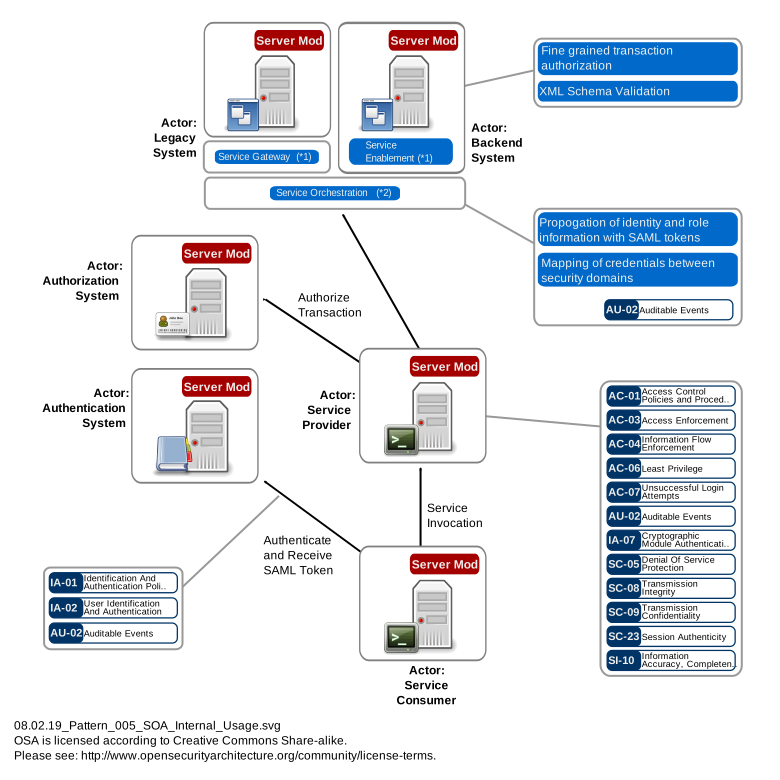
Key Control Areas
Access Control and Authorisation
Authentication and Brute-Force Protection
Transport Security
Denial of Service Protection
Audit and Input Validation
When to Use
Apply this pattern whenever internal services communicate within an enterprise environment, particularly when services handle sensitive data, execute financial transactions, or operate across different internal trust domains. It is essential when composite services chain multiple operations where a security failure at any point in the chain could compromise the entire transaction. Use it when the internal network cannot be assumed to be trusted -- which, following zero trust principles, should be the default assumption. It is particularly important in environments where multiple development teams independently build and deploy services, as the implicit trust between teams may not reflect actual security posture.
When NOT to Use
This pattern may be over-engineered for very small, monolithic applications where all components run in the same process and share the same trust context. If all services are owned, developed, and operated by a single small team within a single security domain, and there is no regulatory requirement for inter-service authentication, a lighter-weight approach may be appropriate. However, even in these cases, consider applying the pattern as the architecture grows -- retrofitting mutual authentication and per-service authorisation is significantly harder than building it in from the start.
Typical Challenges
End-to-end quality of service management for composite services is a major challenge. While SLAs can be defined and monitored for individual services, the dynamic nature of service composition makes end-to-end QoS difficult to guarantee or even measure. Performance overhead from per-transaction authorisation is significant and tends to drive architects toward coarser-grained service interfaces, creating tension between security granularity and performance requirements. Certificate lifecycle management at scale -- provisioning, rotation, and revocation of X.509 certificates across hundreds or thousands of service instances -- requires robust PKI automation. Maintaining consistent security policies across heterogeneous service implementations (different languages, frameworks, and platforms) is operationally demanding. Debugging authentication and authorisation failures in complex service chains is difficult without proper distributed tracing and correlation ID infrastructure.
Threat Resistance
This pattern addresses lateral movement by an attacker who has compromised one internal service and attempts to pivot to others -- mutual authentication and per-service authorisation prevent inherited trust exploitation. It mitigates eavesdropping on internal network traffic through mandatory transport encryption. It resists service impersonation through certificate-based mutual authentication. It prevents privilege escalation through independent per-transaction authorisation with least privilege enforcement. Input validation at each service boundary prevents injection and deserialisation attacks from propagating through composite service chains. Rate limiting and circuit breakers resist denial of service attacks between internal services. Comprehensive audit logging enables detection of anomalous service-to-service communication patterns that indicate compromise.
Assumptions
Service authentication uses X.509 certificates issued by an internal certificate authority, establishing trust through a managed PKI infrastructure. Transaction-level authentication uses SAML tokens or modern equivalents (JWT, OAuth2). Every transaction is authorised independently at each service boundary -- no inherited trust from prior hops. The enterprise service bus or service mesh is implemented in a distributed manner, with security enforcement embedded in each component that contributes to service delivery rather than centralised at a single chokepoint.
Developing Areas
- Zero-trust service-to-service authentication is the stated goal for most organisations but practical implementation lags significantly behind aspiration. Moving from implicit network-based trust to cryptographic workload identity for every internal service requires re-architecting authentication for hundreds or thousands of microservices simultaneously. Most organisations are at best partially deployed, with mTLS enforced in Kubernetes namespaces but legacy services still relying on network segmentation and IP-based allow lists.
- Workload identity standards, particularly SPIFFE (Secure Production Identity Framework for Everyone) and its reference implementation SPIRE, are gaining traction as the interoperable foundation for service-to-service authentication. However, adoption outside cloud-native environments is limited: SPIFFE ID issuance for legacy applications on VMs, mainframes, or proprietary middleware requires custom integration that the specification does not address. The gap between SPIFFE's elegant model and the reality of heterogeneous enterprise estates remains wide.
- Lateral movement detection in microservices architectures is an emerging discipline with immature tooling. Traditional network-based IDS cannot distinguish legitimate east-west traffic from attacker lateral movement when hundreds of services communicate over the same ports and protocols. Behavioural baselines that model normal service communication graphs and alert on deviations are being developed by vendors like Lacework and Wiz, but false positive rates remain high in dynamic environments where service deployments change daily.
- East-west traffic encryption maturity varies dramatically across the industry. While Kubernetes service meshes can automate mTLS, the broader enterprise -- including VM-to-VM communication, database connections, message queue traffic, and legacy protocol integrations -- often transmits sensitive data unencrypted on internal networks. Encrypting all internal traffic is technically feasible but operationally challenging due to certificate management overhead, performance impact on high-throughput systems, and the difficulty of retrofitting encryption into protocols that were never designed for it.
Related Patterns
Patterns that operate within or alongside this one. Click any to view.