Identity Management Pattern
Click any control badge to view its details. Download SVG
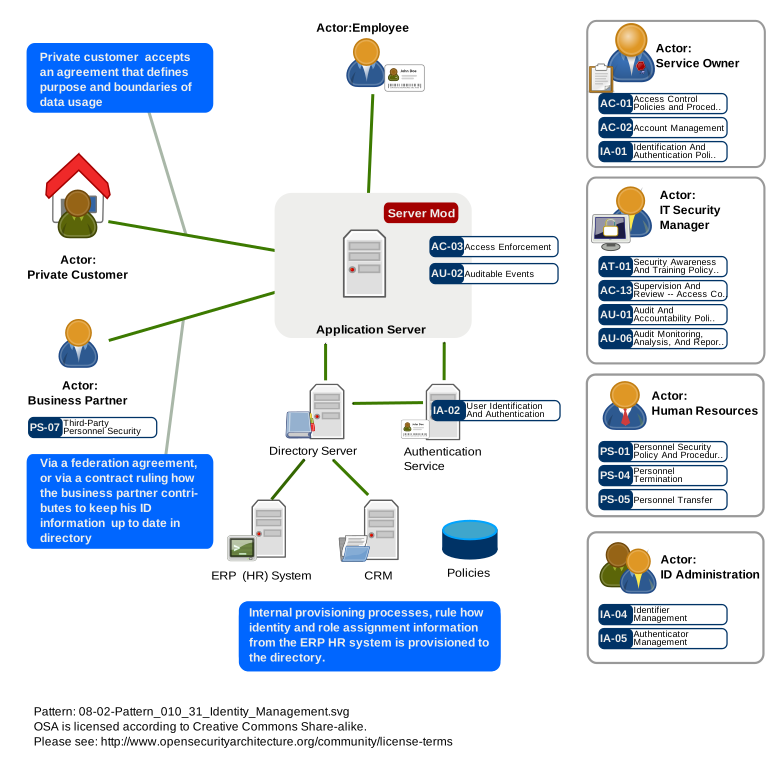
Key Control Areas
Identity Lifecycle Management
Authentication Architecture
Federation and Cross-Boundary Trust
Authorisation and Entitlement Management
Credential and Secrets Management
Privacy and Data Protection
When to Use
This pattern applies to any organisation that stores, processes, or transmits identity information for employees, customers, business partners, or other entities. It is essential when the organisation operates multiple applications requiring authentication, when business processes cross organisational boundaries requiring identity federation, when regulatory requirements mandate specific identity data handling practices, or when the organisation is adopting cloud services that require identity integration. The pattern is also indicated when audit findings identify issues with orphaned accounts, excessive privileges, weak authentication, or lack of access governance.
When NOT to Use
Organisations that do not process personal or confidential identity information and do not store identity data may not require the full scope of this pattern. Very small organisations with a handful of users and a single application may find the full architectural approach disproportionate to their needs, though the principles of credential management and access governance remain relevant at any scale. This pattern focuses on architecture and governance rather than specific technical implementation -- it should be complemented by the appropriate infrastructure patterns (SP-008 for web authentication, SP-011 for cloud IAM, SP-014 for awareness training) for implementation guidance.
Typical Challenges
The oldest enterprise challenge in identity management is synchronisation of identity data between distributed systems. Directory services, HR systems, application databases, cloud identity providers, and partner directories all maintain identity records that must remain consistent. In outsourced and federated scenarios, this challenge extends across network and trust boundaries. Federation requires trust models that span organisations, attribute harmonisation at federation boundaries, and standards compliance from all parties -- each of which introduces friction. Timely provisioning and de-provisioning is a persistent operational challenge: the time between an employee starting work and having all required access (and conversely, the time between departure and full access revocation) directly impacts both productivity and security. Data leakage of identity information is a critical risk in every organisation. Privilege creep -- the gradual accumulation of access rights as personnel move between roles without having old access revoked -- creates excessive entitlements that violate least privilege. The proliferation of machine identities (service accounts, API keys, certificates) often exceeds human identity counts by orders of magnitude and receives far less governance attention.
Threat Resistance
This pattern addresses threats across the identity lifecycle. Credential theft through phishing, keylogging, and database breaches is mitigated by multi-factor authentication, passwordless approaches, and strong credential storage. Account takeover through credential stuffing is resisted by breach detection integration and adaptive authentication. Insider threats from excessive privileges are constrained by entitlement governance, access certification, and separation of duties enforcement. Orphaned account exploitation is prevented by automated de-provisioning tied to authoritative source events. Identity fraud in self-registration scenarios is addressed by identity proofing and verification processes. Federation-based attacks (assertion manipulation, replay, confused deputy) are mitigated by protocol-level protections in SAML and OIDC implementations. Privacy violations from excessive identity data collection or retention are addressed by data minimisation and lifecycle management controls. Machine identity compromise (stolen API keys, expired certificates causing outages) is mitigated by secrets management and automated rotation.
Assumptions
The organisation has an authoritative source of identity data (typically an HR system for employees and a CRM or registration system for customers). A directory service or identity provider exists as the central point of authentication. Network connectivity supports the authentication protocols in use (SAML, OIDC, LDAP, Kerberos). The organisation has defined data classification and risk assessment frameworks that can inform authentication assurance level requirements. Regulatory requirements for identity data handling (GDPR, CCPA, sector-specific rules) have been identified.
Related Patterns
Patterns that operate within or alongside this one. Click any to view.