Secure Ad-Hoc File Exchange Pattern
Click any control badge to view its details. Download SVG
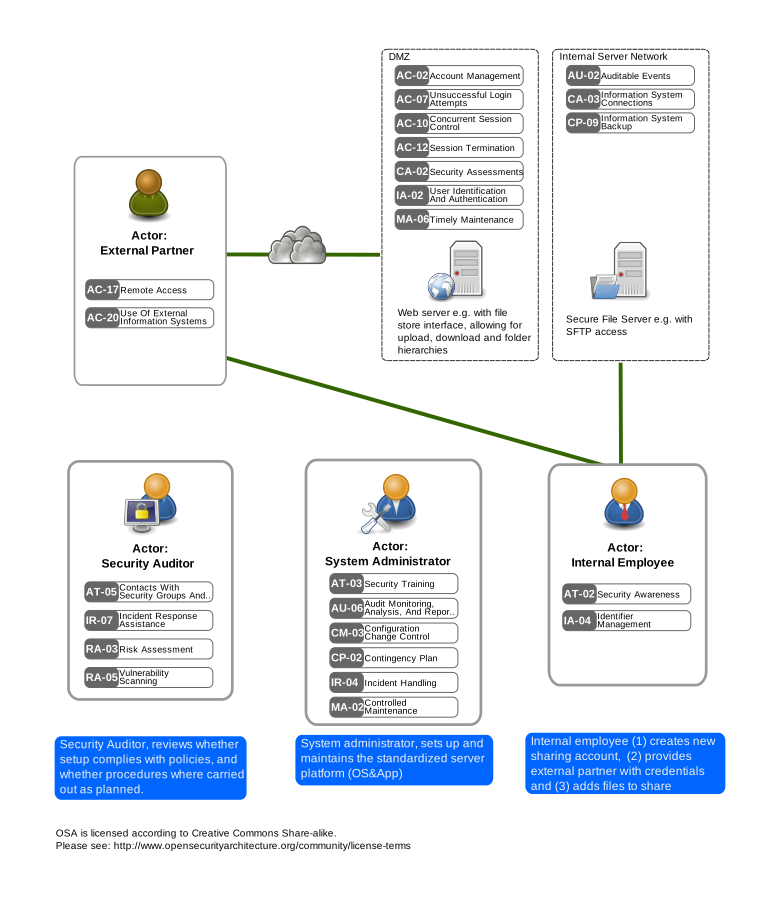
Key Control Areas
Account and Access Management
Cryptographic Protection and Boundary Security
Audit Trail and Monitoring
Security Assessment and Change Management
User Awareness and Training
Risk Assessment and Vulnerability Management
Incident Response and Continuity
When to Use
The pattern is best suited when the following indicators are present: the business drives ad-hoc decisions about when and where the solution is needed; a simplified user interface is required that allows staff with low IT affinity to use the solution; low integration costs are desired; identity federation with the external partner is not established; the business unit is the data owner and staff members decide who needs access, when, and where; an audit trail must be available for compliance; strong authentication (for example with a second factor transmitted via SMS) is likely required for sensitive data. Organisations in regulated sectors (financial services, legal, healthcare) that routinely share confidential documents with external parties. Any organisation that has identified uncontrolled file sharing via email or consumer cloud services as a data loss risk.
When NOT to Use
Strong integration into a document management workflow that requires a single repository for internal and external collaboration -- in this case, a unified collaboration platform (SharePoint Online, Box, Google Workspace) with external sharing controls is more appropriate. Real-time collaboration requirements that demand collaborative editing and in-band update notification -- the ad-hoc exchange pattern is designed for file delivery, not co-authoring. Scenarios where identity federation is already established with the partner organisation, making direct access to shared workspaces more efficient. High-volume, automated file transfers between systems (B2B integration) -- these require managed file transfer (MFT) solutions with scheduling, protocol support, and system-level integration rather than a user-facing ad-hoc solution.
Typical Challenges
User adoption is the primary challenge -- if the secure exchange solution is even slightly less convenient than email or consumer cloud storage, users will bypass it. The interface must be genuinely simple with minimal steps between intent and action. Supporting external recipients who may have varying levels of technical capability, different email systems, and restrictive corporate firewalls that block certain file types or URLs adds complexity. Managing the lifecycle of temporary external accounts at scale, particularly for organisations with high volumes of ad-hoc sharing, requires automation to prevent orphaned accounts and stale data accumulation. Balancing security controls (strong authentication, access restrictions) with the frictionless experience that business users demand is a constant tension. Ensuring the exchange platform itself does not become a malware distribution vector requires content scanning on upload. Large file transfers may encounter practical limitations with web-based platforms, requiring chunked upload support or alternative protocols. Regulatory requirements may restrict where exchanged data can be stored geographically, constraining cloud deployment options. Integration with existing DLP tools to prevent exfiltration of data that should not be shared externally adds implementation complexity.
Threat Resistance
Unauthorised access to shared files by unintended recipients through credential compromise, link sharing, or account reuse. Interception of sensitive data in transit between the exchange platform and external recipients on untrusted networks. Data leakage through uncontrolled file sharing channels when users bypass the secure exchange service. Brute-force and credential-stuffing attacks against the externally accessible authentication interface. Malware delivery through the exchange platform when external parties upload infected files. Platform compromise leading to bulk data exposure. Insider abuse where authorised users share data with unauthorised external parties. Data persistence on the exchange platform beyond its required retention period. Man-in-the-middle attacks during file upload or download. Loss of audit trail integrity undermining regulatory compliance evidence.
Assumptions
Shared data can be classified as confidential and therefore strong encryption is required by most corporate security policies. Data on the move as well as data at rest should be encrypted, and access control policies implement the need-to-know principle. In an ad-hoc scenario it is unlikely that digital rights management solutions (with watermarking and copy prevention) would be required, though integrity assurance on a technical level (for example with hash-value comparison before and after transmission) can be added. Identity federation with external partners is not established -- if it were, a more integrated solution would be appropriate. The business unit is the data owner and IT does not act as data custodian; business unit staff members decide who needs access, when, and to what. The organisation has a data classification scheme that users understand and apply when selecting files for external sharing.
Developing Areas
- End-to-end encrypted file sharing that remains genuinely usable for non-technical recipients is still an unsolved design challenge. Current solutions force a trade-off: either the recipient needs to install software or manage decryption keys (killing adoption), or the platform holds the keys (undermining the end-to-end claim). Emerging approaches using web-based decryption with ephemeral in-browser key derivation show promise but face scrutiny over whether browser-based cryptography provides equivalent assurance to native implementations.
- Data residency compliance for cross-border file transfers is growing more complex as data sovereignty laws proliferate. The EU, China, India, Russia, and an increasing number of jurisdictions impose restrictions on where personal and sensitive data can be stored and processed, yet ad-hoc file sharing inherently involves cross-border transmission. Organisations need file exchange platforms that can enforce geo-fencing policies dynamically, but most current solutions offer only static region selection rather than content-aware routing based on data classification.
- DLP integration for cloud-native file sharing platforms remains immature for ad-hoc external exchanges. While DLP works reasonably well for managed collaboration platforms like SharePoint or Box where content is indexed and persistent, applying DLP to ephemeral file exchanges with time-limited access and encrypted content creates inspection gaps. Inline DLP that can classify and policy-check files during the upload phase before encryption is an emerging capability that few platforms fully support.
- Shadow IT alternatives to sanctioned file exchange continue to proliferate as consumer-grade tools become more capable. Services like WeTransfer, personal Google Drive, and even messaging apps handle large file transfers with zero friction, making them the default choice for users who find enterprise solutions cumbersome. The security architecture challenge is shifting from building secure alternatives to making them competitive on usability while maintaining visibility -- a problem that CASB and SWG solutions partially address but cannot fully solve without endpoint-level controls.
Related Patterns
Patterns that operate within or alongside this one. Click any to view.