Security Monitoring and Response
Click any control badge to view its details. Download SVG
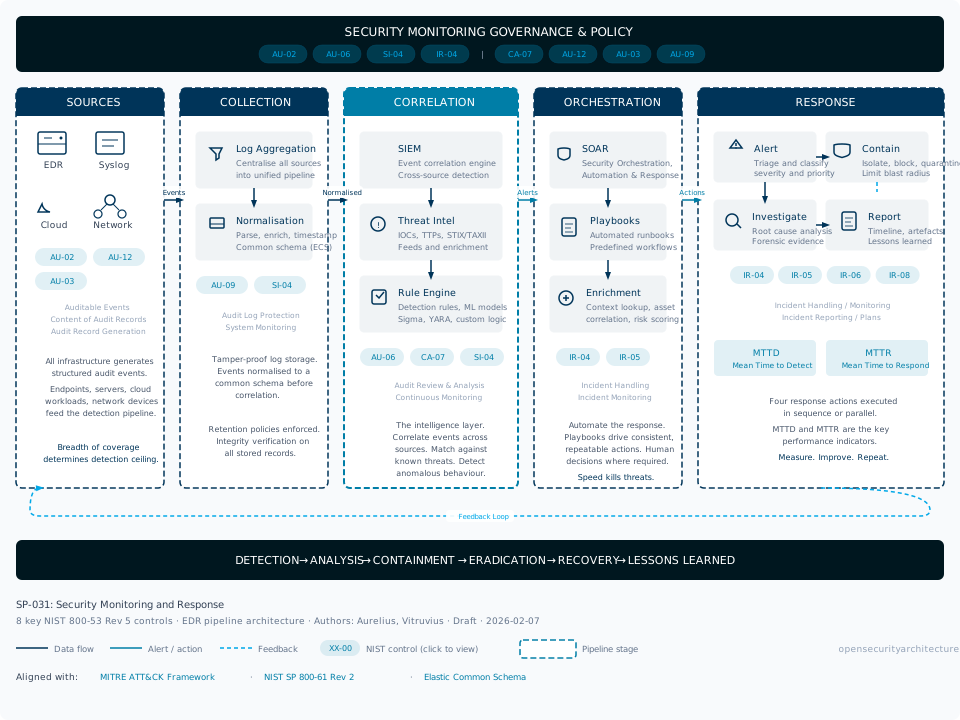
Key Control Areas
Telemetry Collection and Log Management
Correlation, Analytics, and Detection Engineering
Alert Triage, Enrichment, and Orchestration
Automated and Manual Response
Forensics, Evidence Preservation, and Recovery
SOC Operations and Workforce
Threat Intelligence Integration
When to Use
This pattern applies to any organisation that needs to detect and respond to security threats -- which in practice means every organisation. It is particularly critical for organisations in regulated industries (financial services, healthcare, critical infrastructure) where detection and response capabilities are mandated. Organisations with significant cloud workloads need cloud-native detection alongside traditional on-premises monitoring. Those experiencing rapid growth need scalable detection architecture before the estate outgrows ad-hoc monitoring. Any organisation that has suffered a breach where dwell time exceeded days should treat this pattern as urgent.
When NOT to Use
Very small organisations (under 20 users) with simple IT environments may find a full SIEM/SOAR deployment disproportionate and should consider managed detection and response (MDR) services as an alternative. Organisations without basic preventive controls (patch management, endpoint protection, access control) should establish foundations before investing in advanced detection -- you need to reduce the noise floor before detection becomes effective. Air-gapped environments with no internet connectivity have a fundamentally different threat model and monitoring approach.
Typical Challenges
Log volume is the first challenge: a single busy web server generates gigabytes of logs daily, and storage costs for multi-year retention are significant. Alert fatigue is endemic -- poorly tuned SIEM rules generate thousands of false positives that desensitise analysts and bury genuine threats. SIEM deployment often stalls at log collection without progressing to meaningful detection engineering. Correlating events across disparate sources requires normalisation that is never as clean as vendors promise. SOC analyst retention is an industry-wide problem: burnout from shift work, alert fatigue, and repetitive triage drives turnover above 30% annually in many organisations. Measuring SOC effectiveness is difficult -- mean-time-to-detect and mean-time-to-respond are useful but can be gamed. Cloud environments generate novel telemetry formats that traditional on-premises SIEM tools handle poorly. Encrypted traffic (TLS 1.3) limits network-based detection, shifting reliance to endpoint and identity telemetry. SOAR playbook maintenance requires ongoing engineering effort that is often underestimated. Executive expectations of 'real-time detection' clash with the reality that sophisticated adversaries operate within normal user behaviour patterns.
Threat Resistance
Security Monitoring and Response directly addresses the detection and containment phases of the kill chain. Advanced persistent threats with long dwell times are detected through behavioural analytics and anomaly detection (AU-06, SI-04, CA-07). Ransomware is detected at multiple stages: initial access via phishing detection, lateral movement via network anomaly detection, and pre-encryption staging via endpoint behavioural monitoring (SI-04, IR-04). Insider threats are identified through user behaviour analytics that detect anomalous data access, privilege use, and working patterns (AU-06, AC-02, PS-04). Supply chain compromise is detected through software integrity monitoring and update verification (SI-07, SR-10). Credential theft and abuse is detected through impossible travel, anomalous authentication patterns, and failed logon monitoring (AU-02, AC-07, IA-05). Data exfiltration is detected through DLP integration, network flow analysis, and cloud access monitoring (AC-04, SI-04, AU-06). The key architectural principle is defence in depth for detection: no single detection mechanism catches everything, but layered collection, correlation, and analytics create overlapping detection zones that are extremely difficult for adversaries to evade simultaneously.
Assumptions
The organisation has committed to building or procuring security operations capability (in-house SOC, managed SOC, or hybrid). Network architecture supports centralised log collection (agents can reach collectors, bandwidth is sufficient). A log management or SIEM platform is deployed or planned. Endpoints support EDR agent deployment across the estate. Identity providers can emit authentication and authorisation events. Cloud environments expose audit trails via APIs. The organisation has or will develop incident response procedures and playbooks.
Developing Areas
- AI-driven triage accuracy versus analyst trust is the defining tension in modern SOC operations. AI copilots can summarise alerts, suggest investigation steps, and recommend containment actions with impressive speed, but SOC analysts report low confidence in AI recommendations they cannot independently verify. The fundamental challenge is that AI triage operates as a black box -- analysts cannot trace the reasoning chain from raw telemetry to recommendation -- and in a domain where false negatives have severe consequences, trust must be earned through demonstrated accuracy over extended operational periods.
- Detection engineering as a formalised discipline is still being defined. While the concept of treating detection logic with the same engineering rigour as software development (version control, testing, peer review, CI/CD deployment) is gaining acceptance, the profession lacks standardised job descriptions, career paths, training curricula, and certification. The Sigma rules project provides a community-maintained detection corpus, but most organisations still write detections in vendor-specific query languages without systematic coverage analysis or quality assurance processes.
- Security data lake economics are disrupting the traditional SIEM market but creating architectural complexity. The cost per GB of storing security telemetry in cloud object storage (S3, GCS, ADLS) is 10-50x lower than in traditional SIEM platforms, enabling retention of data sources that were previously excluded for cost reasons. However, the trade-off is query latency, real-time alerting capability, and the need to build or buy an analytics layer on top of the raw storage. Most organisations are converging on a hybrid architecture -- hot SIEM for real-time detection and warm data lake for hunting and historical analysis -- but the optimal split between tiers is still being established.
- OCSF and OpenTelemetry convergence for security observability is a developing standards effort that could fundamentally improve cross-platform detection. The Open Cybersecurity Schema Framework (OCSF) provides a vendor-neutral data model for security events, while OpenTelemetry standardises telemetry collection for distributed systems. The convergence of these standards could eliminate the normalisation burden that consumes 30-40% of SIEM engineering effort, but adoption requires vendor commitment that is progressing unevenly, and organisations with existing SIEM investments face migration costs.
- SOAR playbook maintenance burden is generating significant operational debt in organisations that invested heavily in automation. Playbooks that worked at deployment break as integrated APIs change, vendor products update, and the threat landscape evolves. Industry surveys report that the average SOAR deployment has 30-40% of playbooks in a degraded or broken state at any given time, and the engineering resources required for ongoing maintenance were systematically underestimated during procurement. The emerging pattern is fewer, more robust playbooks focused on high-frequency use cases rather than comprehensive automation of the entire incident lifecycle.
Related Patterns
Patterns that operate within or alongside this one. Click any to view.