← Patterns / SP-045

AI Governance and Responsible AI

Organisations deploying AI systems face governance requirements that go far beyond securing the technology itself. Regulators, auditors, and affected individuals increasingly demand answers to questions that traditional security controls were never designed to address: Is the training data representative and free from harmful bias? Can the AI system explain its decisions to affected individuals? Has the organisation assessed the societal impact of deploying this system? Who is accountable when the AI makes a consequential error? NIST 800-53 Rev 5 provides a strong security and privacy foundation, but its 303 active controls achieve only 53% coverage against ISO 42001's AI management clauses. The deepest gaps are in training data quality (30%), transparency and explainability (20%), data labelling and annotation (20%), and human oversight mechanisms (40%). These are not security gaps -- they are governance gaps that require purpose-built controls layered on top of the security baseline. This pattern establishes the AI management system (AIMS) that organisations need to govern AI responsibly. It covers the full AI lifecycle from data acquisition through model retirement, with particular focus on the areas where security controls are necessary but insufficient: training data governance, bias detection, transparency obligations, impact assessment, and meaningful human oversight. It maps directly to ISO/IEC 42001:2023 and addresses EU AI Act, NIST AI RMF, and OECD AI Principles requirements. SP-027 (Secure AI Integration) handles how to deploy AI agents safely -- prompt security, tool authorisation, credential management. This pattern handles the governance question that comes before and around that deployment: should we deploy this AI system, under what constraints, with what oversight, and how do we demonstrate it is operating responsibly?
Release: 2.0 Authors: Spinoza, Vitruvius Updated: 2026-02-13
Assess
ATT&CK This pattern addresses 451 techniques across 13 tactics View on ATT&CK Matrix →
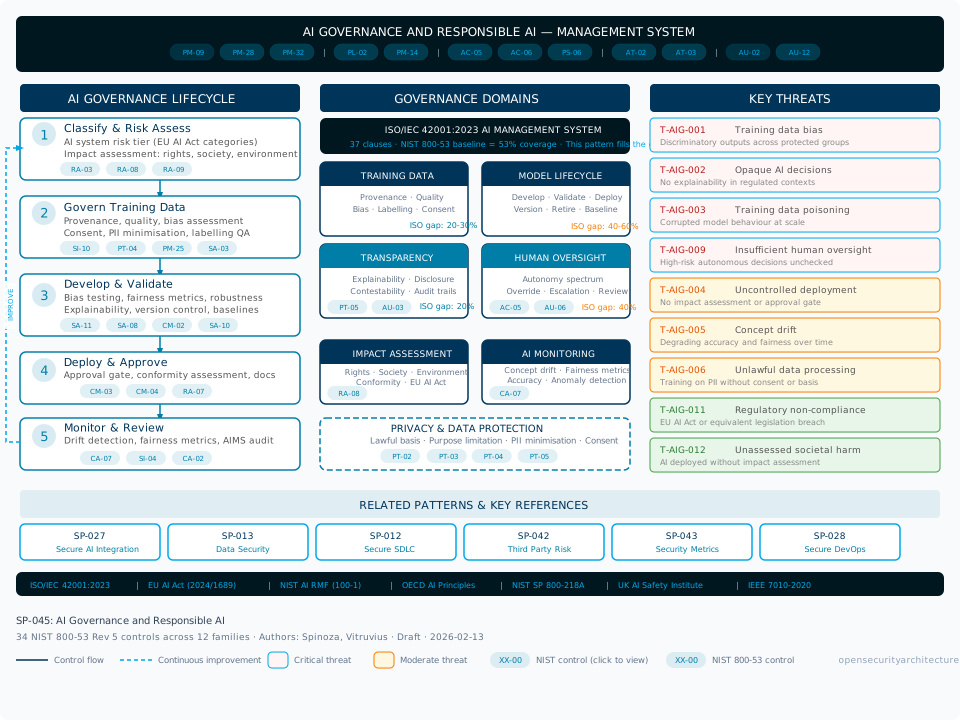
AI GOVERNANCE AND RESPONSIBLE AI — MANAGEMENT SYSTEM PM-09 PM-28 PM-32 | PL-02 PM-14 | AC-05 AC-06 PS-06 | AT-02 AT-03 | AU-02 AU-12 AI GOVERNANCE LIFECYCLE 1 Classify & Risk Assess AI system risk tier (EU AI Act categories) Impact assessment: rights, society, environment RA-03 RA-08 RA-09 2 Govern Training Data Provenance, quality, bias assessment Consent, PII minimisation, labelling QA SI-10 PT-04 PM-25 SA-03 3 Develop & Validate Bias testing, fairness metrics, robustness Explainability, version control, baselines SA-11 SA-08 CM-02 SA-10 4 Deploy & Approve Approval gate, conformity assessment, docs CM-03 CM-04 RA-07 5 Monitor & Review Drift detection, fairness metrics, AIMS audit CA-07 SI-04 CA-02 IMPROVE GOVERNANCE DOMAINS ISO/IEC 42001:2023 AI MANAGEMENT SYSTEM 37 clauses · NIST 800-53 baseline = 53% coverage · This pattern fills the gaps TRAINING DATA Provenance · Quality Bias · Labelling · Consent ISO gap: 20-30% MODEL LIFECYCLE Develop · Validate · Deploy Version · Retire · Baseline ISO gap: 40-60% TRANSPARENCY Explainability · Disclosure Contestability · Audit trails ISO gap: 20% PT-05 AU-03 HUMAN OVERSIGHT Autonomy spectrum Override · Escalation · Review ISO gap: 40% AC-05 AU-06 IMPACT ASSESSMENT Rights · Society · Environment Conformity · EU AI Act RA-08 AI MONITORING Concept drift · Fairness metrics Accuracy · Anomaly detection CA-07 PRIVACY & DATA PROTECTION Lawful basis · Purpose limitation · PII minimisation · Consent PT-02 PT-03 PT-04 PT-05 KEY THREATS T-AIG-001 Training data bias Discriminatory outputs across protected groups T-AIG-002 Opaque AI decisions No explainability in regulated contexts T-AIG-003 Training data poisoning Corrupted model behaviour at scale T-AIG-009 Insufficient human oversight High-risk autonomous decisions unchecked T-AIG-004 Uncontrolled deployment No impact assessment or approval gate T-AIG-005 Concept drift Degrading accuracy and fairness over time T-AIG-006 Unlawful data processing Training on PII without consent or basis T-AIG-011 Regulatory non-compliance EU AI Act or equivalent legislation breach T-AIG-012 Unassessed societal harm AI deployed without impact assessment RELATED PATTERNS & KEY REFERENCES SP-027 Secure AI Integration SP-013 Data Security SP-012 Secure SDLC SP-042 Third Party Risk SP-043 Security Metrics SP-028 Secure DevOps ISO/IEC 42001:2023 | EU AI Act (2024/1689) | NIST AI RMF (100-1) | OECD AI Principles | NIST SP 800-218A | UK AI Safety Institute | IEEE 7010-2020 SP-045: AI Governance and Responsible AI 34 NIST 800-53 Rev 5 controls across 12 families · Authors: Spinoza, Vitruvius · Draft · 2026-02-13 Control flow Continuous improvement Critical threat Moderate threat XX-00 NIST control (click to view) XX-00 NIST 800-53 control opensecurityarchitecture.org

Click any control badge to view its details. Download SVG
Key Control Areas

  • AI Management System Establishment (PM-09, PM-28, PM-14, PL-02): An AI management system requires explicit governance structures: an AI policy approved at board or executive level, defined roles and accountabilities (AI ethics lead, model risk owner, data governance lead), and a risk appetite statement specific to AI. PM-09 (Risk Management Strategy) anchors the AIMS to the enterprise risk framework -- AI risk is not a separate category but a dimension of operational, reputational, legal, and ethical risk. PM-28 (Risk Framing) ensures the organisation defines what constitutes acceptable and unacceptable AI risk, including bias thresholds, fairness criteria, and autonomy boundaries. The AIMS should define a tiered classification for AI systems (following EU AI Act risk categories: unacceptable, high, limited, minimal) that determines the depth of assessment, testing, and oversight required. ISO 42001 Clause 5 requires leadership commitment and Clause 4 requires understanding the organisational context for AI -- neither maps to a single NIST control but the combination of PM-09 and PM-28 provides the closest foundation.
  • Training Data Governance (SI-10, PM-25, PT-02, PT-04, SA-03): Training data is the single largest determinant of AI system behaviour, yet it receives less governance attention than model architecture in most organisations. SI-10 (Information Input Validation) provides the baseline -- but for AI, validation means representativeness analysis, bias assessment, and quality metrics, not just format checking. Organisations must establish data quality standards for training datasets: completeness, accuracy, timeliness, representativeness across protected characteristics, and absence of proxy variables for discrimination. PM-25 (Minimization of PII) constrains what personal data enters training pipelines -- collect only what is necessary and justified. PT-02 (Authority to Process PII) and PT-04 (Consent) ensure lawful basis exists for every piece of personal data used in training, particularly under GDPR Article 6 and EU AI Act transparency requirements. Data provenance must be documented: where did each dataset come from, who labelled it, what annotation guidelines were used, and what quality checks were performed. SA-03 (System Development Life Cycle) ensures data governance is embedded in the model development process, not bolted on afterward. The 20% ISO 42001 coverage on data labelling (A.7.4) reflects the reality that no NIST control addresses inter-annotator agreement, labelling bias, or annotation quality -- these require supplementary organisational controls.
  • Model Lifecycle Management (SA-11, SA-08, SA-10, CM-02, CM-03, CM-04): Every AI model should follow a governed lifecycle: development, validation, approval, deployment, monitoring, and retirement. SA-11 (Developer Security Testing) extends to AI-specific testing: bias testing across protected characteristics, fairness validation using accepted metrics (demographic parity, equalised odds, calibration), adversarial robustness testing, and boundary case analysis. SA-08 (Security Engineering Principles) includes responsible AI by design -- privacy by design, fairness by design, and transparency by design embedded from the start, not retrofitted. CM-02 (Baseline Configuration) requires model baselines: pinned versions, documented hyperparameters, training data snapshots, and performance benchmarks that enable rollback. CM-03 (Configuration Change Control) governs model updates -- no model should reach production without passing through a defined approval gate that includes bias regression testing. CM-04 (Impact Analysis) requires that every model change be assessed for downstream impact: does retraining change outputs for specific populations? Does a fine-tuning run introduce new failure modes? Model retirement is equally important: when a model is superseded, decommission it completely rather than allowing shadow usage of deprecated versions.
  • Transparency and Explainability (PT-05, PT-03, AU-02, AU-03): Transparency is the most significant gap between NIST 800-53 and ISO 42001 (20% coverage on A.8.2). Organisations must establish what level of explanation is required for each AI system based on its risk tier and regulatory context. PT-05 (Privacy Notice) extends to AI transparency: affected individuals should be informed when AI is involved in decisions that affect them, what data is used, and how to contest outcomes. PT-03 (PII Processing Purposes) requires that the purpose of AI processing is clearly defined and communicated -- function creep from the stated purpose is a governance violation. AU-02 (Event Logging) and AU-03 (Content of Audit Records) require decision-level audit trails: not just that a decision was made, but what inputs drove it, what model version produced it, what confidence score it had, and whether a human reviewed it. For high-risk AI systems under the EU AI Act, technical documentation must include system capabilities and limitations, intended purpose, accuracy metrics, and known biases. The right to explanation under GDPR Article 22 requires that automated decisions significantly affecting individuals can be meaningfully explained -- this demands explainability techniques (SHAP, LIME, attention visualisation) integrated into the model deployment pipeline, not added as an afterthought.
  • AI Risk and Impact Assessment (RA-03, RA-07, RA-08, RA-09): AI risk assessment must go beyond traditional information security risk to include bias risk, fairness risk, societal impact, and ethical considerations. RA-03 (Risk Assessment) provides the framework, but AI-specific risk categories must be defined: discriminatory outcomes, privacy violations through inference, environmental impact of training compute, labour market displacement, and manipulation potential. RA-08 (Privacy Impact Assessments) extends to AI impact assessments (AIAs) covering fundamental rights, societal effects, and environmental costs -- the EU AI Act requires conformity assessments for high-risk systems. RA-07 (Risk Response) must include AI-specific responses: bias detected above threshold triggers retraining, fairness metrics failing triggers deployment pause, impact assessment finding triggers design review. RA-09 (Criticality Analysis) determines which AI systems require the most rigorous governance: systems making consequential decisions about individuals (credit, employment, healthcare, law enforcement) demand the highest tier of assessment, testing, and oversight. The 45% ISO 42001 coverage on impact assessment (A.5.4) reflects NIST's security focus -- human rights impact, environmental impact, and societal impact require supplementary assessment frameworks.
  • Human Oversight and Override (AC-05, PS-06, AT-02, AT-03, AC-06): Meaningful human oversight is not a checkbox -- it requires that the human reviewer has the competence, authority, time, and information to make an informed decision. AC-05 (Separation of Duties) ensures the person who builds the model is not the sole approver of its deployment. PS-06 (Access Agreements) should explicitly address AI-assisted decision-making: who is accountable when human and AI collaborate on a decision? AT-02 and AT-03 (Security Awareness and Role-Based Training) must include AI literacy: understanding model limitations, recognising hallucination, interpreting confidence scores, and knowing when to override AI recommendations. AC-06 (Least Privilege) constrains which AI systems can make autonomous decisions versus which require human approval. The organisation must define an autonomy spectrum per AI system: fully automated (no human review), human-on-the-loop (human monitors), human-in-the-loop (human approves), and human-in-command (human decides, AI assists). High-risk systems should default to human-in-the-loop or human-in-command. ISO 42001 A.9.2 (Human Oversight) has only 40% NIST coverage because no 800-53 control specifically addresses human override mechanisms for AI decisions.
  • Responsible AI Monitoring (CA-07, SI-04, AU-06, CA-02): Post-deployment monitoring is where most AI governance programmes fail. CA-07 (Continuous Monitoring) must include AI-specific metrics: model accuracy over time (concept drift), fairness metrics across protected groups (statistical parity difference, equalised odds ratio), output distribution analysis (detecting mode collapse or anomalous patterns), and input data drift (training-serving skew). SI-04 (System Monitoring) extends to monitoring for adversarial inputs, data poisoning attempts, and model extraction attacks. AU-06 (Audit Record Review) ensures AI decision logs are actually reviewed -- not just collected -- with escalation triggers for anomalous patterns. CA-02 (Control Assessments) requires periodic review of the entire AIMS: are the governance controls working, are risk assessments current, are impact assessments still valid, and have new regulatory requirements emerged? Define specific monitoring thresholds: if fairness metrics deviate by more than X% from baseline, trigger investigation. If accuracy drops below Y%, trigger retraining review. If complaint volume exceeds Z per month, trigger impact reassessment. ISO 42001 A.2.4 (AI System Monitoring) at 55% NIST coverage reflects that concept drift monitoring and fairness metrics are not addressed by traditional security monitoring controls.

When to Use

Organisation deploys AI systems that make or support decisions affecting individuals (credit, employment, insurance, healthcare, law enforcement). EU AI Act applies to the organisation's AI systems. ISO 42001 certification is planned or required by customers. AI systems process personal data subject to GDPR or equivalent privacy regulation. Audit findings related to AI transparency, bias, or accountability. Board or executive requesting assurance that AI is governed responsibly. Customers or regulators asking how AI decisions are made and can be contested.

When NOT to Use

Organisation uses AI only for internal, non-consequential tasks (e.g., code completion, document formatting) with no impact on individuals. All AI usage is covered by SP-027's operational security controls and no regulatory AI governance requirements apply. Organisation has no current or planned AI deployments.

Typical Challenges

Defining 'fairness' is context-dependent and contested -- demographic parity may conflict with equalised odds, and different stakeholders may prefer different definitions. Training data provenance is difficult to establish for large-scale datasets, particularly foundation models trained on internet-scale data. Explainability techniques trade off fidelity with simplicity -- the most accurate explanation may not be the most understandable. AI impact assessments lack the methodological maturity of privacy impact assessments and often produce subjective conclusions. Responsible AI monitoring requires ML engineering capability that many governance teams lack. The pace of AI capability advancement outstrips governance framework development. Dual-use concerns: the same model may be low-risk in one context and high-risk in another. Board-level AI literacy is often insufficient for meaningful oversight of AI risk appetite decisions.

Threat Resistance

AI Governance addresses the governance failures that security controls alone cannot prevent. Training data bias leading to discriminatory outputs is mitigated through mandatory representativeness analysis, bias testing, and fairness metrics thresholds with automated deployment gates. Opaque AI decisions in regulated contexts are addressed through transparency obligations, explainability requirements scaled to risk tier, and decision-level audit trails that enable meaningful review and contestation. Uncontrolled model deployment is prevented by the model lifecycle with mandatory impact assessment, bias regression testing, and approval gates. Concept drift degrading fairness over time is detected through continuous monitoring with defined thresholds and automated escalation. Shadow AI models outside governance are contained through AI inventory requirements, acceptable use policies, and discovery mechanisms. The pattern's emphasis on human oversight with competence requirements ensures that human-in-the-loop controls are meaningful rather than rubber-stamp exercises.

Assumptions

The organisation deploys or intends to deploy AI systems that process personal data, make or support consequential decisions, or operate with a degree of autonomy. A centralised AI governance function exists or will be established (this may sit within risk, compliance, privacy, or a dedicated AI ethics team). The organisation has access to AI/ML engineering competence to implement bias testing, fairness metrics, and explainability techniques. NIST 800-53 Rev 5 controls are the security and privacy baseline; this pattern adds governance controls on top of that foundation. The regulatory landscape for AI is evolving rapidly -- this pattern should be reviewed quarterly.

Developing Areas

  • EU AI Act implementation timelines are creating urgent compliance tooling gaps. The regulation entered into force in August 2024 with a phased implementation schedule: prohibited AI practices from February 2025, high-risk system obligations from August 2026, and full enforcement from August 2027. However, harmonised standards under the Act are still being developed by CEN/CENELEC, meaning organisations must build compliance programmes against requirements whose detailed technical specifications are not yet finalised. The conformity assessment ecosystem (notified bodies, technical documentation templates, testing methodologies) is at least 12-18 months from maturity.
  • Algorithmic auditing standards are fragmented across multiple initiatives without convergence. IEEE 7003, NIST AI RMF, ISO 42001 Annex A, and emerging EU AI Act conformity requirements each define audit criteria differently. No single methodology has achieved the adoption and credibility that SOC 2 or ISO 27001 have for information security, leaving organisations unable to demonstrate responsible AI through a recognised, auditable standard. The IAASB (International Auditing and Assurance Standards Board) is developing assurance guidance for AI, but publication is not expected before 2027.
  • AI incident reporting frameworks are in early development but lack the maturity of cybersecurity incident reporting. The OECD AI Incidents Monitor and the AI Incident Database collect reports voluntarily, but no jurisdiction has yet mandated AI incident reporting comparable to GDPR breach notification or DORA ICT incident reporting. The EU AI Act requires serious incident reporting for high-risk systems, but the definition of a serious AI incident, the reporting timeline, and the competent authority are still being clarified through implementing acts.
  • Bias detection and fairness metrics standardisation remains contested because fairness itself is context-dependent and mathematically constrained. Demographic parity, equalised odds, and calibration are mutually incompatible in most scenarios (Chouldechova impossibility theorem), meaning organisations must choose which definition of fairness to optimise for -- a normative decision that technical metrics cannot resolve. The tooling for bias detection (IBM AI Fairness 360, Google What-If, Microsoft Fairlearn) is mature for tabular data but poorly adapted to generative AI outputs, where bias manifests in language, imagery, and reasoning patterns that resist quantitative measurement.
  • AI supply chain governance -- particularly foundation model provenance -- is an urgent emerging challenge. Organisations building on third-party foundation models (GPT, Claude, Gemini, Llama) typically cannot verify training data composition, bias characteristics, or safety testing performed by the model provider. The EU AI Act places obligations on deployers of high-risk systems that use third-party models, creating a governance requirement that the supply chain does not yet support with adequate transparency documentation, model cards, or contractual assurances.
AC: 2AT: 2AU: 4CA: 2CM: 3PL: 1PM: 5PS: 1PT: 4RA: 4SA: 4SI: 2
AC-05 Separation of Duties
AC-06 Least Privilege
AT-02 Literacy Training and Awareness
AT-03 Role-Based Training
AU-02 Event Logging
AU-03 Content of Audit Records
AU-06 Audit Record Review, Analysis, and Reporting
AU-12 Audit Record Generation
CA-02 Control Assessments
CA-07 Continuous Monitoring
CM-02 Baseline Configuration
CM-03 Configuration Change Control
CM-04 Impact Analysis
PL-02 System Security and Privacy Plans
PM-09 Risk Management Strategy
PM-14 Testing, Training, and Monitoring
PM-25 Minimization of Personally Identifiable Information
PM-28 Risk Framing
PM-32 Purposing
PS-06 Access Agreements
PT-02 Authority to Process Personally Identifiable Information
PT-03 Personally Identifiable Information Processing Purposes
PT-04 Consent
PT-05 Privacy Notice
RA-03 Risk Assessment
RA-07 Risk Response
RA-08 Privacy Impact Assessments
RA-09 Criticality Analysis
SA-03 System Development Life Cycle
SA-08 Security and Privacy Engineering Principles
SA-10 Developer Configuration Management
SA-11 Developer Testing and Evaluation
SI-04 System Monitoring
SI-10 Information Input Validation