SaaS Identity Lifecycle Management
Click any control badge to view its details. Download SVG
Key Control Areas
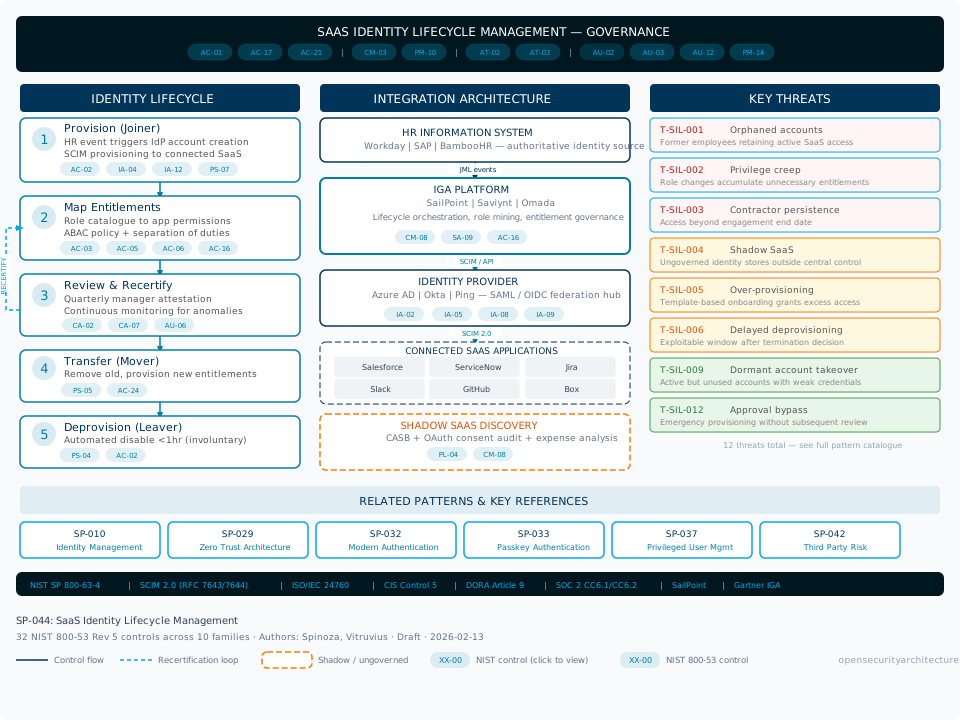
- Automated Provisioning and Onboarding (AC-02, IA-04, IA-12, PS-07): The foundation of identity lifecycle management is automated provisioning from an authoritative source -- typically the HR information system (HRIS) or equivalent. When a new employee, contractor, or partner is created in the HR system, the identity governance platform should automatically create accounts in the identity provider and downstream SaaS applications based on role templates. AC-02 (Account Management) is critical here, requiring defined account types, assignment of account managers, and establishment of conditions for group and role membership. IA-04 (Identifier Management) ensures unique identifiers are assigned and managed across the lifecycle. IA-12 (Identity Proofing) establishes that identity verification occurs before access is granted, particularly important for remote onboarding where in-person verification is impractical. PS-07 (External Personnel Security) requires that security requirements for contractors and external personnel are established before access is provisioned, including background screening and contractual obligations.
- Role-Based Entitlement Mapping (AC-03, AC-05, AC-06, AC-16, AC-24): Translating business roles (job titles, departments, cost centres) into application-level permissions is where most identity programmes struggle. The pattern requires a role catalogue that maps each business role to a set of SaaS application entitlements. AC-03 (Access Enforcement) ensures that access decisions are based on defined policy, not ad-hoc requests. AC-05 (Separation of Duties) prevents toxic role combinations -- an accounts payable clerk should not also have supplier master data access. AC-06 (Least Privilege) constrains each role to the minimum entitlements required. AC-16 (Security and Privacy Attributes) enables attribute-based access control (ABAC) where entitlements depend on dynamic attributes like department, location, project assignment, or clearance level rather than static role membership alone. AC-24 (Access Control Decisions) supports policy decision points that evaluate multiple attributes in real time.
- Contractor and Temporary Access Governance (IA-08, PS-07, AC-02, AT-02): Contractors, consultants, and temporary workers represent the highest-risk identity population because their access is time-bounded but often not time-limited in practice. IA-08 (Identification and Authentication for Non-Organisational Users) establishes authentication requirements for external users that match or exceed those for employees. PS-07 (External Personnel Security) requires contractual agreements covering security responsibilities, access limitations, and termination obligations. AC-02 mandates that temporary and emergency accounts have automatic expiry dates -- contractor accounts should be created with a defined end date that requires active renewal rather than persisting until someone remembers to remove them. AT-02 (Literacy Training and Awareness) should include contractor-specific security awareness covering the organisation's acceptable use policies and data handling requirements.
- Access Reviews and Recertification (CA-02, CA-07, AU-06): Periodic access reviews are the primary control against privilege creep. CA-02 (Control Assessments) requires regular evaluation of whether access grants remain appropriate. AC-02 requires review of accounts for compliance with account management requirements at a defined frequency. CA-07 (Continuous Monitoring) enables ongoing access monitoring rather than point-in-time reviews alone. The pattern recommends quarterly manager attestation for standard users and monthly review for privileged or sensitive-data access. Reviews should surface changes since the last review period -- new entitlements added, role changes, and cross-application access aggregation that may not be visible in any single application's access report. AU-06 (Audit Record Review, Analysis, and Reporting) supports investigation of access anomalies flagged during reviews.
- Deprovisioning and Offboarding (PS-04, PS-05): Deprovisioning is the most time-critical phase of the identity lifecycle. PS-04 (Personnel Termination) requires that access is revoked promptly upon termination, including retrieval of credentials and disabling all system access. PS-05 (Personnel Transfer) requires review and modification of access when personnel change roles, ensuring old entitlements are removed, not just new ones added. The pattern mandates automated deprovisioning triggered by HR system status changes, with a target of all SaaS access revoked within 1 hour of termination for involuntary departures and 24 hours for voluntary departures. SCIM deprovisioning should disable accounts (not delete them, to preserve audit trails) across all connected SaaS applications simultaneously. Manual deprovisioning checklists are required for SaaS applications without SCIM connectors.
- SaaS Application Inventory and Governance (CM-08, SA-09, PL-04): You cannot govern identity lifecycle for applications you do not know about. CM-08 (System Component Inventory) requires maintaining a current inventory of all SaaS applications with their identity integration status (SCIM-connected, SAML-federated, standalone). SA-09 (External System Services) requires that security requirements are established for each SaaS provider, including identity integration capabilities, data residency, and incident notification obligations. Shadow SaaS discovery -- identifying applications adopted outside central procurement -- should be part of continuous monitoring. PL-04 (Rules of Behaviour) establishes acceptable use policies that require all SaaS adoption to go through the identity governance process.
- Audit Trail and Compliance (AU-02, AU-03, AU-12, PM-14): Every identity lifecycle event must be logged for compliance and forensic purposes. AU-02 (Event Logging) requires logging of account creation, modification, enabling, disabling, and removal events across all SaaS applications. AU-03 (Content of Audit Records) specifies that logs include who made the change, what changed, when, and why (approval reference). AU-12 (Audit Record Generation) ensures consistent log generation across the SaaS estate. PM-14 (Testing, Training, and Monitoring) requires periodic testing of identity lifecycle controls. These audit trails serve multiple compliance requirements simultaneously -- SOX access reviews, GDPR right-to-erasure verification, and SOC 2 CC6.1/CC6.2 access provisioning evidence.
When to Use
Organisation has more than 20 SaaS applications. Audit findings related to orphaned or excessive access. Contractor population exceeds 10% of total workforce. Previous security incidents involving former employee access. Regulatory requirements for access certification (SOX, PCI DSS, DORA). Help desk ticket volume for access provisioning and deprovisioning is high.
When NOT to Use
Small organisations with fewer than 10 SaaS applications may find manual lifecycle management sufficient. Organisations with purely on-premises infrastructure should consider SP-010 (Identity Management) instead. If the organisation has not yet implemented centralised authentication (SP-032), that should come first.
Typical Challenges
SaaS applications with no SCIM support require manual provisioning workarounds. Role explosion as the number of unique permission combinations grows with SaaS count. Contractor onboarding often bypasses HR systems, requiring separate authoritative sources. Access reviews suffer from 'rubber stamping' where managers approve all access without genuine review. Shadow SaaS adoption undermines centralised governance. Mergers and acquisitions introduce conflicting identity models that take months to reconcile.
Threat Resistance
SaaS Identity Lifecycle Management addresses the full spectrum of access accumulation and orphaned identity threats. Orphaned accounts after employee departure are eliminated through automated deprovisioning triggered by HR system events, closing the window of opportunity that attackers exploit for persistent access. Privilege creep from role changes is systematically detected through periodic access reviews that surface accumulated entitlements, preventing the gradual accumulation of unnecessary access that insiders or compromised accounts can leverage. Contractor access that persists beyond engagement end dates is controlled through mandatory expiry dates and sponsor attestation, addressing one of the most common audit findings in regulated industries. Shadow SaaS provisioning is contained through application inventory and acceptable use policies, reducing the attack surface of ungoverned identity stores. The pattern's emphasis on audit trails and compliance evidence provides the forensic foundation needed for incident response and regulatory reporting.
Assumptions
The organisation uses a centralised identity provider (IdP) for SSO across its SaaS estate. An HR information system (HRIS) or equivalent serves as the authoritative source for employee and contractor identity data. SaaS applications support SAML/OIDC for authentication and ideally SCIM for provisioning. The organisation has a defined role model or is willing to create one. Management is willing to participate in periodic access reviews.
Developing Areas
- SaaS sprawl discovery automation is improving but coverage gaps remain significant. CASBs detect traffic-based SaaS usage, SSO logs reveal federated application access, and expense report analysis finds paid subscriptions, but free-tier SaaS applications accessed from personal devices on personal networks remain invisible to all three methods. Estimates suggest 30-40% of SaaS applications in use at a typical enterprise are unknown to IT, and the proliferation of AI-powered tools adopted by individual employees is accelerating the shadow SaaS problem.
- SCIM provisioning adoption across SaaS vendors is uneven and inconsistently implemented. Major platforms (Salesforce, ServiceNow, Google Workspace, Microsoft 365) support SCIM well, but mid-market and vertical SaaS applications frequently offer partial SCIM implementations -- supporting user creation but not group management, or supporting disable but not attribute updates. The result is that organisations with 100+ SaaS applications typically achieve SCIM coverage for 40-60% of their estate, with the remainder requiring manual provisioning workarounds or custom API integrations.
- Offboarding completeness verification -- confirming that all SaaS access has actually been revoked after an employee departure -- lacks reliable automated tooling. SCIM deprovisioning confirms the API call succeeded but does not verify that the user cannot still access the application through cached sessions, API tokens, or OAuth grants created outside the IdP. Emerging identity governance platforms are building post-deprovisioning verification scans, but the absence of a standard API for querying active sessions across SaaS applications means verification remains incomplete.
- SaaS-to-SaaS integration visibility is a growing blind spot in identity governance. When a user grants Zapier access to their Salesforce and Slack accounts via OAuth, or connects a project management tool to a code repository, these SaaS-to-SaaS integrations create trust relationships that bypass centralised identity governance. The OAuth grants persist even after the user's access is revoked from the originating application, creating orphaned integration pathways. Mapping and governing these inter-application connections is an emerging capability that most identity governance platforms do not yet address.
- SaaS Security Posture Management (SSPM) is an emerging market category that extends identity lifecycle management to include configuration monitoring, permission analysis, and compliance verification across SaaS estates. SSPM platforms (Adaptive Shield, Obsidian Security, Valence) provide visibility into SaaS misconfiguration, excessive permissions, and data sharing that identity governance platforms miss. However, the market is fragmented, API coverage varies by SaaS vendor, and integration with existing IGA platforms is still maturing.