Zero-Knowledge Proof Architecture
Click any control badge to view its details. Download SVG
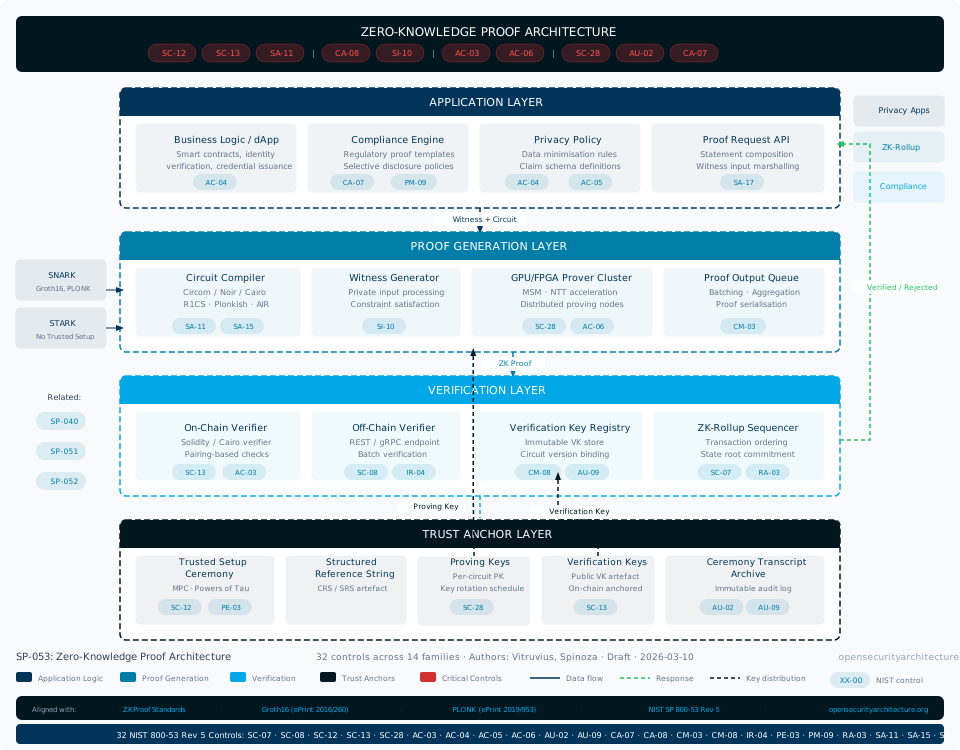
Key Control Areas
Trusted Setup Ceremony Security
Circuit Security and Auditing
Proving Infrastructure Security
Verification Key Integrity and Distribution
ZK-Rollup Infrastructure Security
Privacy-Preserving Applications
ZK Compliance Applications
Post-Quantum Considerations
When to Use
Use this pattern when: (1) proving regulatory compliance to regulators or counterparties without disclosing confidential business data; (2) deploying a ZK-rollup for transaction throughput or L2 scaling; (3) building privacy-preserving transaction systems for financial applications; (4) implementing selective disclosure for KYC/AML credentials; (5) building confidential computing applications where even the cloud provider should not see computation inputs.
When NOT to Use
Do not use ZK proofs when: simpler cryptographic techniques (TLS, HSM-based signing, secure multi-party computation) solve the problem without the complexity overhead; the team lacks ZK cryptographic expertise (implementation bugs are catastrophic); real-time performance requirements cannot tolerate proof generation latency; or the regulatory environment explicitly requires full transaction transparency (some jurisdictions prohibit privacy-enhancing technologies for financial transactions).
Typical Challenges
The most dangerous challenge is the invisible soundness bug: under-constrained circuits can be exploited silently, with no on-chain evidence of forgery. Circuit auditing is a specialised skill requiring months to develop. Trusted setup ceremony logistics are genuinely difficult — coordinating hundreds of participants across jurisdictions with verifiable hardware attestation. Proof generation latency is often unacceptable for real-time applications without GPU/FPGA investment. Verification key governance — updating keys after circuit bug fixes — requires new ceremonies and creates upgrade governance risks. GDPR compliance with ZK commitments is a genuine tension: once a commitment is on-chain it cannot be erased, but if the private witness (containing personal data) is retained, a DSAR could require disclosure of witness data that would reveal proof inputs.
Threat Resistance
This pattern primarily resists: forged proof acceptance (soundness bugs, compromised trusted setups), proving infrastructure attacks (DoS, key extraction), verification key substitution, ZK-rollup sequencer censorship and data withholding, and privacy compromise through metadata analysis. It does not address: smart contract vulnerabilities in the application layer (see SP-051), consensus-layer attacks on the underlying L1, or regulatory non-compliance where ZK proofs are not accepted as evidence.
Assumptions
Organisations deploying ZK proof systems are assumed to have cryptographic engineering expertise on staff or through specialist advisors. General software security teams cannot safely audit ZK circuits without ZK-specific training. Trusted setup ceremonies require advance planning (months), diverse international participation, and verifiable contribution tooling. On-chain verifier deployment is assumed to be on an EVM-compatible network (Ethereum, ZK-rollup L2); Solana, Aptos, and Sui have native ZK verification primitives but with different security properties. Off-chain ZK applications (enterprise batch verification) avoid blockchain-specific risks but retain all cryptographic and proving infrastructure risks.
Developing Areas
- ZK-powered compliance and regulatory reporting is emerging as one of the highest-value enterprise applications of zero-knowledge proofs. Financial institutions are exploring selective disclosure of transaction data to regulators — proving AML compliance, sanctions clearance, and capital adequacy without revealing counterparty identities, trade details, or proprietary strategy. Chainalysis and Elliptic are investigating ZK-based AML proofs that would allow exchanges to demonstrate their entire transaction graph is sanctions-clean without exposing the graph itself to the regulator. The fundamental tension is between financial transparency (regulators need assurance) and commercial privacy (firms need confidentiality): ZK proofs offer a mathematical resolution, but regulatory acceptance remains uneven. The EU’s AML Package (Regulation 2024/1624) and FATF’s 2025 updated guidance on privacy-enhancing technologies both acknowledge ZK proofs as a potential compliance mechanism, though neither yet provides a definitive approval framework. Organisations building ZK compliance systems must design for regulatory evolution — the proof statements accepted today may need to be extended as supervisors’ technical sophistication grows and disclosure expectations shift.
- Post-quantum ZK proof systems represent a critical migration challenge for SNARK-based deployments. ZK-STARKs are already post-quantum secure by construction (relying on collision-resistant hash functions rather than elliptic curve pairings), but their larger proof sizes (typically 50–200 KB vs. 128 bytes for Groth16) and higher on-chain verification costs make them unsuitable for some latency- and cost-sensitive applications. Lattice-based SNARK research — including lattice-based polynomial commitments and the Brakedown proof system from academic groups — aims to deliver SNARK-like succinctness with post-quantum security, but these constructions remain pre-production with significant performance gaps. The NIST Post-Quantum Cryptography standardisation (FIPS 203–205, finalised 2024) does not directly address ZK proof systems, leaving a guidance vacuum for organisations that need to plan SNARK-to-STARK or SNARK-to-lattice migration paths. Recursive STARK composition (as used by StarkNet’s SHARP prover) maintains post-quantum security throughout the recursion chain, making it the safest current choice for new deployments with long-lived security requirements. See SP-040 Post-Quantum Cryptography for algorithm-level guidance on migration planning and crypto-agility architecture.
- Hardware acceleration and proving-as-a-service are transforming ZK proof generation from a software engineering problem into an infrastructure market. Dedicated ZK ASIC development by Ingonyama (ICICLE framework), Cysic, and Accseal targets order-of-magnitude speedups over GPU-based provers, with early benchmarks showing 10–100x improvements for specific circuit types (MSM, NTT operations). GPU prover clusters — often running on NVIDIA A100/H100 infrastructure — are already production-critical for ZK-rollups: zkSync Era and Polygon zkEVM rely on specialised GPU prover services for their block production cadence. The proving-as-a-service market is emerging rapidly, with =nil; Foundation’s Proof Market, Aligned Layer, and Gevulot offering decentralised proving networks where proof generation is outsourced to competitive provers. However, this creates a centralisation risk: if proving becomes concentrated in a small number of infrastructure providers (analogous to cloud computing’s oligopoly), ZK-rollup liveness depends on those providers’ availability and integrity. Organisations consuming proving services must evaluate provider diversity, geographic distribution, fallback proving capacity, and the trust assumptions introduced when witness data (potentially containing private inputs) is sent to a third-party prover.
- Client-side proving on mobile and edge devices is an active frontier that would enable privacy-preserving identity verification, credential presentation, and transaction signing without requiring server-side prover infrastructure. WebAssembly (WASM)-based provers — including SnarkJS, Circom WASM targets, and Halo2 WASM builds — can now generate simple ZK proofs on modern smartphones in 2–10 seconds, enabling use cases such as proving age-over-18 from a government credential without revealing date of birth, or proving membership in a KYC-verified set without contacting the KYC provider. Latency and battery constraints remain significant: complex circuits (those with millions of constraints) can take 30+ seconds and consume substantial battery on mobile, making UX design critical for adoption. The Semaphore protocol and Zupass (developed for Zuzalu) demonstrate production client-side proving for anonymous group membership and event ticketing. Offline ZK proof generation — creating proofs without network connectivity and submitting them later — is particularly valuable for humanitarian and financial inclusion applications where connectivity is intermittent. Security architecture for client-side proving must address witness data protection on the device (preventing extraction of private inputs via malware or side-channel attacks), secure circuit distribution (ensuring the user’s device runs the correct circuit), and proof freshness (preventing replay of stale proofs).
- Formal verification of ZK circuits is becoming a critical security requirement as ZK systems move from research prototypes to production infrastructure managing billions of dollars in value. Circuit bugs are catastrophic security failures: the 2022 Hermez double-spending vulnerability (an under-constrained circuit allowing duplicate nullifiers) and the 2019 Zcash Sapling counterfeiting bug (a missing validation in the JoinSplit circuit that could have allowed unlimited token creation, discovered internally before exploitation) demonstrate that circuit correctness cannot be established by testing alone. Emerging formal verification tools include Ecne (automated constraint verification for Circom circuits), StarkWare’s Lean-based formal verification of Cairo programs, and Veridise’s Picus tool for detecting under-constrained signals. Circuit auditing methodology is maturing but remains far less standardised than smart contract auditing: there is no equivalent of the Ethereum Foundation’s audit standards or the OWASP Smart Contract Top 10 for ZK circuits. The 0xPARC ZK Bug Tracker catalogues known circuit vulnerabilities and provides a taxonomy (under-constrained, over-constrained, witness computation errors, trusted setup flaws), but the field lacks standardised circuit testing frameworks, coverage metrics, and certification pathways. Organisations deploying ZK systems in regulated environments should mandate independent circuit audits by ZK specialist firms (Trail of Bits, Zellic, Veridise), require formal verification of critical constraint systems, and maintain a circuit vulnerability disclosure and patching process analogous to smart contract bug bounty programmes.
Related Patterns
Patterns that operate within or alongside this one. Click any to view.